Smart Speaker Comparison 2026: Best Picks by Room and Budget
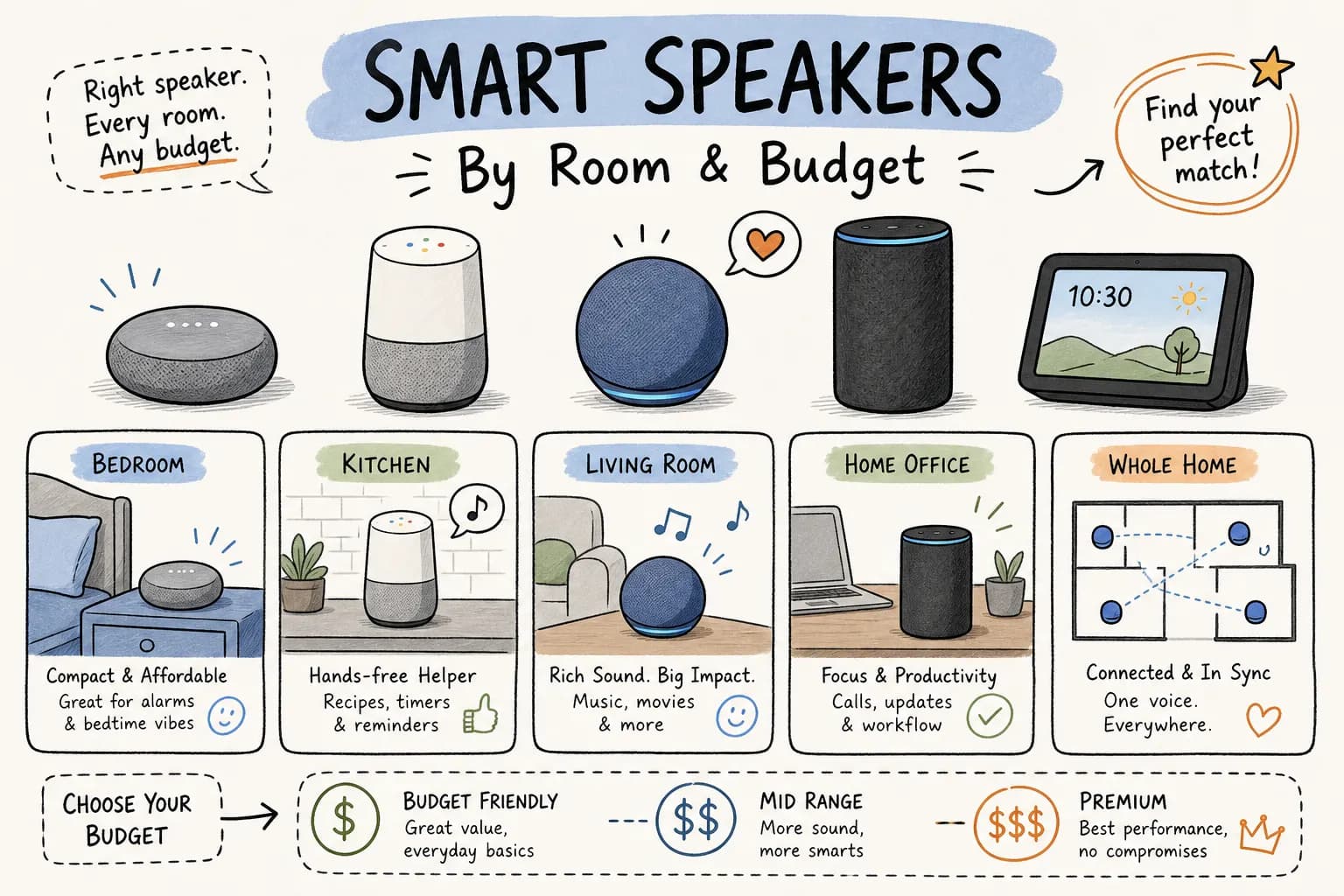
Every brand claims their smart speaker is the best. Alexa says it controls everything. Google says it understands everything. Apple says it sounds better than everything. None of that marketing copy tells you whether Alexa fumbles when you ask it to dim your kitchen lights at 11 PM, or whether HomePod 2's bass actually justifies $299 for someone who already owns three non-Apple devices. That's where this smart speaker comparison cuts through the noise.
I keep things straightforward here at Gadget Guy's Smart Home: no brand sponsorships, no PR samples with strings attached, just 30+ years of hands-on tech experience and a genuine need for these things to work reliably in an actual home. This guide scores six models across four criteria: sound quality, smart home control, ease of use, and price-to-value ratio. By the end, you'll have a short three-question checklist to make your decision quickly and confidently.
How this smart speaker comparison was done
What models made the cut
Six speakers made the shortlist: Amazon Echo Dot, Echo Dot Max, Echo Studio, Google Nest Audio, Apple HomePod 2, and JBL Authentics 500. The selection criteria were simple: widely available in the US, covering budget through premium pricing, and representing all three major voice assistant ecosystems. Any speaker not sold at major US retailers or not actively receiving firmware updates in 2026 didn't make the list.
The four criteria used
- Sound quality: Frequency extension, max volume, distortion behavior, and spatial audio support where applicable.
- Smart home control: Ecosystem breadth, routine capability, andMatter protocol support.
- Ease of use: Setup time, app quality, and accessibility for less tech-savvy users.
- Price-to-value ratio: Street price compared against what you actually get in everyday use, not what the spec sheet promises.
- Alexa: Open the Alexa app, go to Settings, then Alexa Privacy, and enable auto-delete of voice recordings set to 3 months.
- Google: Go to myactivity.google.com and confirm that audio activity saving is turned off under Web & App Activity.
- Siri: On your iPhone, go to Settings, then Privacy & Security, then Analytics & Improvements, and turn off "Improve Siri & Dictation."
Sound quality: smart speaker comparison results by tier
Budget and midrange listening
The Echo Dot Max (22W, rated 4.5/5 by PCMag) is a strong entry-level pick for smaller rooms. It handles podcasts, news briefings, and casual music listening without complaint. Google Nest Audio performs comparably in the midrange tier and has a warmer tonal balance that some listeners prefer for spoken content. Neither speaker extends deep bass convincingly, and neither will fill a large living room, but both are genuinely good for what they are.
Premium sound: where the real differences show up
This is where the smart speaker comparison gets interesting. Echo Studio has the most objective audio data behind it: RTINGS measured a 55.8 Hz low-frequency extension, and DXOMARK recorded max playback levels between 84.8 and 91 dB SPL depending on content type. Wirecutter's lab testing found the Echo Studio hits 94.1 dB max volume versus 87.2 dB for HomePod 2, and produced 82.0 dB CTA-2010 bass output compared to 71.5 dB for HomePod. Echo Studio also supports Dolby Atmos and Sony 360 Reality Audio, which is meaningful differentiation at its $199, $219 price point.
HomePod 2 and JBL Authentics 500 don't have the same depth of published lab data, but both draw consistent praise from reviewers for room-filling clarity and spatial presentation. HomePod 2 uses Apple's computational audio to adapt to the room, and the result sounds polished rather than powerful. For pure, data-backed audio performance, Echo Studio wins. For Apple household listeners who value refinement over raw output, HomePod 2 is the better fit. JBL Authentics 500 is the dark horse: Dolby Atmos support and a premium build make it worth a look for anyone prioritizing living room sound quality over assistant features.
Alexa vs. Google Assistant vs. Siri: who controls your home better?
Alexa's edge in device compatibility
Alexa supports between 140,000 and 300,000 compatible smart home devices depending on how integrations are counted, roughly three times Google Home's 50,000+ and more than 100 times HomeKit's 1,000+ devices. For a mixed smart home with devices from multiple brands, Alexa is the most reliable choice. Its routine builder lets you chain complex automations without a dedicated hub, and Matter protocol support on Echo 4th gen and newer models continues to expand compatibility further.
Google Assistant and Gemini for conversational use
Google Assistant sits just behind Alexa for device control but pulls ahead on natural language and follow-up questions. The Gemini integrations introduced in recent updates make Google's answers noticeably more contextual on factual or open-ended queries. If your household relies heavily on Google Calendar, Gmail, and Search integration, Nest Audio paired with Google Assistant can be a strong fit, though keep in mind the gap in overall smart home device breadth is real, and it matters most if your setup includes devices outside the Google or Nest ecosystem.
Siri and HomePod: built for Apple households
Siri on HomePod works seamlessly when your iPhone, Apple TV, and HomeKit accessories are already in sync. Device handoff between Apple products is smooth, and the experience feels cohesive in a way neither Alexa nor Google can fully replicate within their own ecosystems. Outside of Apple HomeKit, though, Siri struggles to keep pace. HomePod earns its place in an Apple-first home; it's a frustrating fit for anyone running a mixed-brand setup.
Privacy: what these speakers actually do with your voice
Default data retention across all three platforms
This is where the three platforms differ most noticeably. Amazon Echo saves voice recordings indefinitely by default unless you change the setting manually. Retention can be set to 3 months, 18 months, or disabled entirely, but the out-of-box default keeps recordings tagged to your account until you act. Google Nest links voice activity to your Google account with auto-delete available, though the exact default depends on your account settings at setup. Apple HomePod is the most restrictive by default: Siri requests are tied to a random device identifier rather than your Apple account, and Apple does not retain audio unless you opt in to sharing it for Siri improvement.
All three platforms use hardware-level microphone mute buttons, not just software toggles. That distinction matters because a hardware disconnect physically cuts the microphone circuit rather than relying on software to stop listening. If privacy is your primary concern, HomePod 2's defaults are the most restrictive of the three by a meaningful margin.
Three privacy settings worth changing right now
Smart speaker comparison by price: the right pick at every budget
Under $60: best entry-level smart speaker
The Amazon Echo Dot is the go-to for beginners and renters. It's small, easy to set up, deeply integrated with Alexa, and frequently discounted below its already modest price. Sound quality is limited, but for voice control, timers, routines, and casual audio in a bedroom or kitchen, it handles the job without fuss. If you're brand new to smart home devices, this is the lowest-risk starting point available.
$100, $200: where you get the most for your money
This midrange tier is the sweet spot for most buyers. Echo Dot Max at $99.99 and Echo Studio at $219.99 (often discounted to $189.99) both live here. Echo Studio wins on measurable audio performance, with Dolby Atmos support adding real differentiation at this price. Google Nest Audio competes well in this range if your home runs primarily on Google services. For anyone who hasn't committed to an ecosystem yet, Echo Studio at its sale price of $189.99 delivers the strongest combination of audio quality and smart home capability in this price range.
$200 and up: when premium is worth it
HomePod 2 and JBL Authentics 500 occupy the premium tier. HomePod 2 justifies its price mainly within an Apple ecosystem; if your home is already HomeKit-native, the seamless integration and computational audio make it worth the investment. JBL Authentics 500 is worth considering for pure audio quality in a living room or open-plan space where assistant features matter less than how it sounds. Both models regularly drop $50 to $100 from MSRP, so a quick price check before purchasing takes 60 seconds and can save real money.
Which smart speaker should you actually buy?
A quick smart speaker buyer's guide checklist
Start with the ecosystem question. If you have an iPhone, HomeKit devices, and an Apple TV, HomePod 2 is the natural fit and eliminates half the field immediately. If you're on Android or running a mixed-brand setup, Alexa or Google Assistant will serve you better. This single question removes most of the decision complexity.
Next, ask whether music quality is a top priority. If you're replacing a Bluetooth speaker and want something that genuinely sounds good, step up to Echo Studio or HomePod 2. If you mainly want voice control, news briefings, and smart home automation, Echo Dot or Nest Audio are more than enough and cost significantly less. Don't pay for audio quality you don't need.
Finally, consider your privacy comfort level. Apple's approach is the most restrictive by default, which makes HomePod 2 the safest choice if data retention concerns you more than ecosystem breadth or price. Alexa and Google both offer the tools to tighten privacy settings, but you have to take that step manually. For most buyers, the ecosystem question resolves everything else: match the speaker to the platform you already live in.
Before clicking any product link below, a 30-second price check is worth the habit. Prices shift regularly, and readers have saved real money on more than one of these models just by checking first.
Bottom line
This smart speaker comparison makes one thing clear: no single speaker wins across every category. Echo Studio leads on measurable audio output and Dolby Atmos support. Alexa leads on smart home device breadth with 140,000+ compatible devices. Google Assistant leads on conversational intelligence and search-quality answers. HomePod 2 leads on privacy defaults and Apple ecosystem integration. The right choice depends entirely on which of those priorities matters most to you.
Use the three-question checklist above before clicking any product link: ecosystem first, audio priority second, privacy preference third. Answer those honestly and the decision practically makes itself. Bookmark this smart speaker comparison, Gadget Guy's Smart Home updates it as firmware changes and new hardware rolls out, so you'll always have current information when it's time to add another room to your setup.
Share this article
Help others discover this content


